
What Aristotle Knew About The Friendships That Last.

This is week four of the Isolation at Altitude Series. Last week we sat with the Cheerleader Problem, the discovery that a thought partner you had relied on for years could no longer meet you at the altitude you now operated in. This week, we turn to something different. Not a shift in a relationship. A discovery about what a relationship was built on all along.
Some friendships are built to last a season. Some are built to last a lifetime. Aristotle named the difference between the two twenty-three hundred years ago, in the Nicomachean Ethics, and it still holds today.
The first is what Aristotle called a friendship of utility. These friendships form around shared work. A committee. A project. A team. A season of professional life you moved through together. The bond is real, and the utility is not a lesser reason for friendship to exist. These friendships are simply calibrated to the season they inhabit.
The second is what Aristotle called a friendship of character. These friendships form around who each person is at their core, not around what each person offers within a shared circumstance. They tend to be fewer, because they require deeper recognition to form. And they tend to last longer, because they are not calibrated to any season. They travel with you across every one.
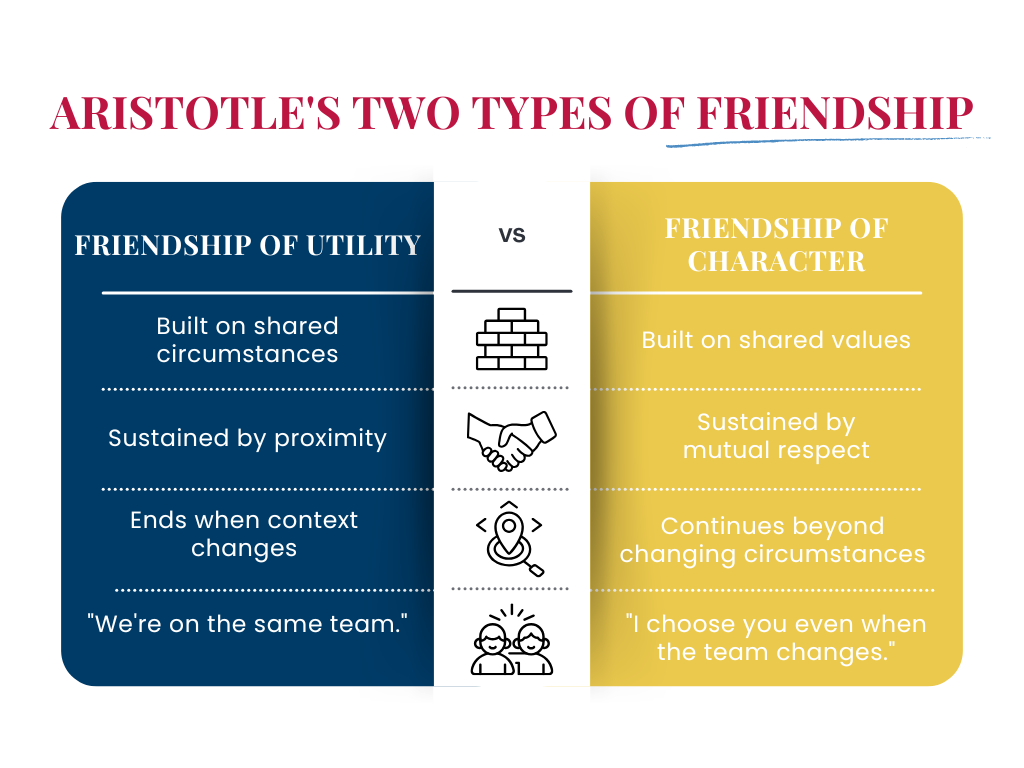
I did not know Aristotle had named this when I lived it.
For me, it was a woman I considered a sister of sorts.
We had known each other for fifteen years. We had risen through the organization at similar levels, which meant we were in the same rooms, hearing the same leadership conversations, navigating the same organizational dynamics. We knew each other's vulnerabilities. We had supported each other through difficult seasons both professionally and personally. From where I stood, this was one of the most real and enduring relationships in my professional life.
When I made the decision to leave corporate, I never questioned whether that relationship would survive the transition. We had fifteen years. We had depth. We had history that had nothing to do with the building we both happened to work in.
I was gone for a week before the silence started.
Not a gradual drift. A complete absence. No calls. No texts. Nothing. When I looked back honestly at the architecture of that relationship, I could see something I had not been willing to see while I was inside it. I had always been the one to initiate. I would share vulnerably first. She would meet me there. I would reach out. She would respond warmly. But the energy, the initiation, the forward momentum of the relationship had always come from me. What I had interpreted as mutual depth was real on my side. On hers, it was largely maintained by the daily proximity of shared context.
This is what the Proximity Trap is. A friendship of utility misread as a friendship of character.
You may look back on a moment like this and feel foolish for having believed the depth was mutual. That response is human, not unwise.
This is different from the Cheerleader Problem in a way worth naming. The Cheerleader Problem is what happens when a genuine thought partnership gets outgrown by your altitude. The relationship's foundation was character. The altitude simply moved past what she could meet you at. The Proximity Trap is the opposite. The relationship's foundation was utility. You believed it was character. When the utility disappeared, the foundation showed itself.

🔜 The Always On Problem comes next.
Once a quarter, I host The Exchange, a Connection Experience for women of impact who are ready to build friendships of character alongside women who share their altitude. It is free, invite-only, and curated.
My next Exchange is coming up in August. If you would like to attend, email me to find out more.

🤏TINY TWEEK Challenge
Pick one professional friendship you have relied on. Look at it through Aristotle's lens. Is it built on character, or on context? Do not assign a value judgment to the answer. A utility friendship is not a lesser friendship. It is a differently built one. The tweak is to see it clearly, not to change it.
