
My Husband Offered Me Money for C's.

Have you ever found yourself paralyzed by a fear that your work isn’t good enough? Or perhaps it shows up as a feeling that your endeavor just “isn’t quite ready”?
The result is a delay in getting your work done. This delay might show up on a report, a pitch, an email, or even just a meeting you need to schedule. Whatever the form, the root cause is the same: perfectionism.
I have a long history of fighting perfectionism as my go-to procrastination method. I’m wired to push myself to “do my best,” but my best often gets in my way. My perfectionism is also a handy excuse to hide my fears and insecurities. Anyone else out there the same?
Let me share a humorous true story.
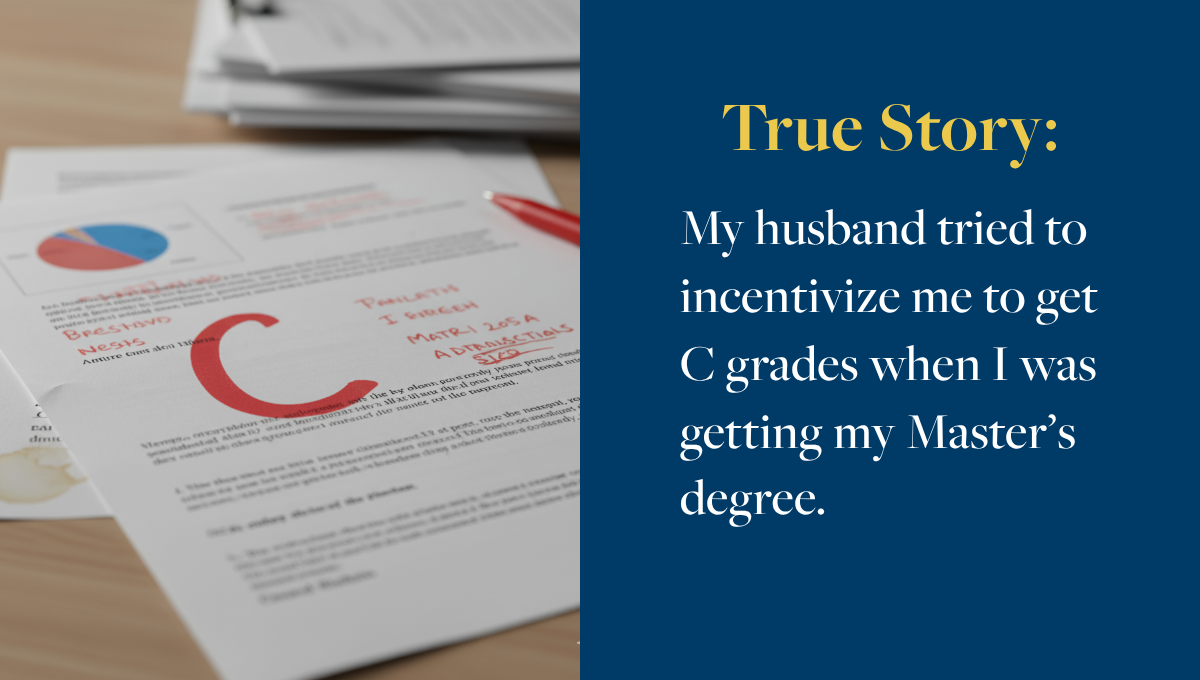
Yes… You read that right: A’s and B’s didn’t pay, but C’s did! He was trying to help me learn what was “good enough.” He saw me struggling to keep up with my own exacting standards and thought he’d try to support me by paying me to get C’s. Sadly, it didn’t work! We were both frustrated by my inability to let go of my perfectionist tendencies.
Since then, I’ve studied perfectionism and found a few tricks that help me pull back the reins. Here are my top 3 tricks. Pro tip: They work best when you use all three of them at the same time.
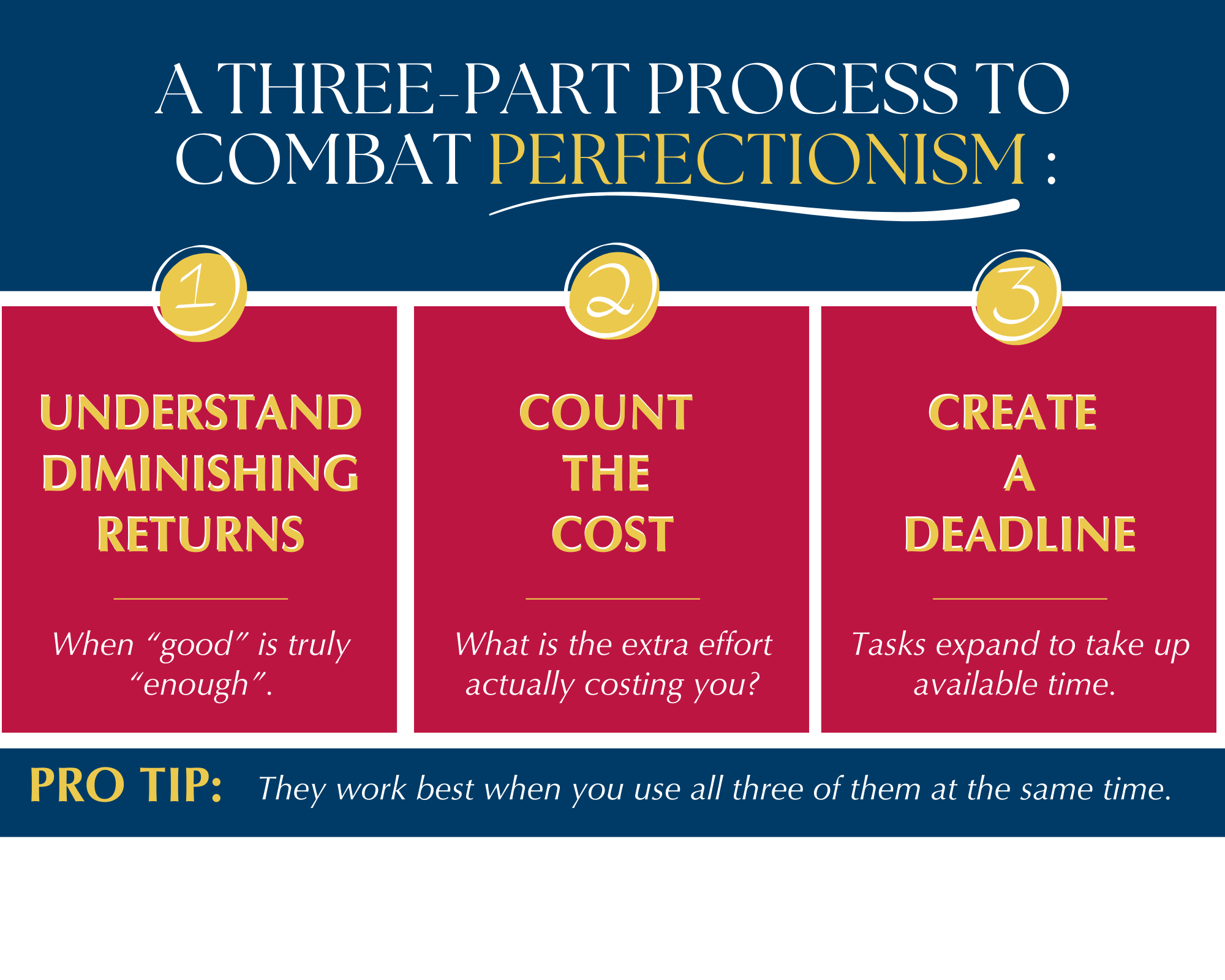
1. Understand The Law of Diminishing Returns
What it is:
An economic principle stating that there’s a point where the amount of effort you put into something stops producing equally valuable results. The first hour you spend on a report creates 80% of its value. The fifth hour might only add 1%, tweaking fonts, rewording a perfectly good sentence, or finding a slightly better synonym.
How it helps:
Perfectionism lives in that 1% zone. It’s the voice telling you that 99% isn’t 100%. By naming this “law,” you give your logical brain a reason to stop. You can say, “I am now in the land of diminishing returns. The extra time I’m spending is not worth the tiny improvement I’ll get.”
Try this:
Ask yourself, “Is this 95% ‘good’ version sufficient to achieve the goal?” If the answer is yes, hit send.
2. Count the Opportunity Cost
What it is:
The “cost” of what you give up by choosing to do something else. The time you spend on one task is time you can never get back.
How it helps:
Perfectionism tries to convince you that this one task is the only thing that matters. But when you spend three extra hours polishing a presentation that’s already “good enough,” you are actively losing three hours you could have spent starting your next project, calling a new client, or even just resting so you’re more effective tomorrow.
Try this:
When you’re stuck in a loop of endless tweaks, ask yourself, “What am I not doing right now by choosing to perfect this?” Often, the value of the next task is far greater than the 1% improvement you’re chasing.
3. Set Deadlines (Even Artificial Ones)
What it is:
A non-negotiable due date. Perfectionism hates a vacuum, but it really hates a deadline. My mom always says, “If you want a clean house, throw a party.” She’s right!
How it helps:
A deadline forces you to make decisions. It stops the endless “what if” cycle and forces you to commit. It is the single best tool for shipping “good enough” work. This is based on Parkinson’s Law: “Work expands so as to fill the time available for its completion.”
Try this:
If you don’t have an external deadline, create one. I like to schedule work that will tempt me into perfection 60–90 minutes before a meeting. When time runs out, I have to live with whatever I’ve created and send it off. This external accountability is a powerful weapon against the internal voice of perfectionism.
👇 Putting It All Together
Here’s how to use them in combination:
Start by setting a Deadline (Tip 3).
“I will finish this task by 11 AM.”As you work and the deadline gets closer, ask yourself if you’ve hit the Law of Diminishing Returns (Tip 1).
Seal the deal by reminding yourself of the Opportunity Cost (Tip 2):
“If I keep fiddling with this, I won’t have time for my next task.”
This three-part check gives you the permission you need to stop, be proud of your “good enough” work, and move on—because we all know that…

When we wait for perfect conditions, we lose the very thing that creates success—momentum. Imperfection always wins because it builds confidence, clarity, and results.
🎯 Your Challenge:
Take one imperfect step forward. Send that message. Launch that project. Share your work, even if it’s not flawless. You’ll be amazed at how much progress follows once you stop waiting for perfection.
And for those who like a personal update: yes, my house is decorated for Christmas. 🎄 If that surprises you, you may enjoy the story behind it in my reflections about expectations, joy, and purpose.